Field guide · Trades & Main Street
AI for Auto Repair Shops
Two stories reach the bay: the trade is finished, or none of it matters. This book is about the third one — the writing that piles up between the car and the customer.
Words for this work: mechanic, auto tech, technician, garage, car repair, automotive, service advisor, service writer, body shop, tire shop, oil change, transmission, ASE, collision, auto shop.
The short answer
For auto repair shops, the writing an AI chat tool is genuinely good at is the writing around the work rather than the work itself: writing estimates and translating tech findings, status updates, approval requests, the phone that never stops, invoices, warranty claims, fleet billing, payment chasing, review responses and complaint letters, ro notes, tsb reading, customer explanations, and marketing you keep putting off. Chapter by chapter that is about eleven hours in a normal week — That’s eleven hours in a normal week. Your first week will be slower — you’re learning a tool. By week three, the numbers above are realistic. Chapter 12 gives you the 30-day plan to get there.
What it does not do: your job. It does not writing estimates and translating tech findings for you without you reading it first. And it has one dangerous habit worth knowing before you type anything into it. The AI’s one dangerous habit: stating false things (prices, labor times, part numbers, torque specs, state laws) in a confident voice. The industry calls it “hallucination.” The fix is the 60-second check: numbers, promises, rules.
Where the hours go
Six blocks of writing, largest first, as the book counts them. The chapter each one is worked through in is on the right. These are the figures from this book's own promise page — the same table for all twenty-five books is on one page here.
- Writing estimates and translating tech findings~3 hoursChapter 4
- Status updates, approval requests, the phone that never stops~2 hoursChapter 5
- Marketing you keep putting off~2 hoursChapter 9
- Invoices, warranty claims, fleet billing, payment chasing~1.5 hoursChapter 6
- RO notes, TSB reading, customer explanations~1.5 hoursChapter 8
- Review responses and complaint letters~1 hourChapter 7
That’s eleven hours in a normal week. Your first week will be slower — you’re learning a tool. By week three, the numbers above are realistic. Chapter 12 gives you the 30-day plan to get there.
The eight kinds of writing
The 150 prompts in the book are grouped the way the work is grouped. It is the shape of a week for auto repair shops, whether or not you ever buy anything: if your week looks like this list, the tool has somewhere to start.
- 1–15Setup & Voice15 prompts
- 16–40Estimates & Service Writing25 prompts
- 41–65Customer Communication25 prompts
- 66–85Money & Paperwork20 prompts
- 86–105Reviews & Reputation20 prompts
- 106–120On the Job15 prompts
- 121–145Marketing & Growth25 prompts
- 146–150Admin & Momentum5 prompts
All 150 titles are listed free, and twelve are printed in full.
Three of the prompts, in full
Not a sampler: these are the three the book itself rates highest. Its promise page values six blocks of writing in hours, and these come from the three worth the most — one prompt each, printed as they stand. The bracketed parts are where you type; everything else is the wording. Nine more are printed in full on the prompt page for this book, and every one of the 150 is listed there by name.
“Turn my notes into a customer-ready estimate explanation: WHAT YOU BROUGHT IT IN FOR (their complaint, their words), WHAT WE FOUND (plain English, one sentence per finding on what the part does and what’s wrong), WHAT WE RECOMMEND (in priority order), WHAT CAN WAIT (stated honestly). Every price and labor amount stays $____. Nothing is safe, guaranteed, or legally required unless I said it. No scare tactics. Under 250 words. Notes: [VOICE RAMBLE].”
“Write my 10 standard customer texts in my voice: appointment confirmation with drop-off instructions, vehicle received/inspection underway, diagnosis done — estimate within the hour, approved and started with realistic ready-time, parts delay with new timeline, ready for pickup with total, 3-day estimate follow-up, after-hours auto-reply (tow-it-now vs. wait-for-morning criteria), comeback acknowledgment, review request. Under 45 words each, [BRACKETS] for variables.”
“Write my Google Business Profile: description under 750 characters naming services and [AREA] naturally; services list with one-sentence plain descriptions for [SERVICES]; answers to the 8 questions drivers always ask (my make? loaner/shuttle? how fast? appointment needed? warranty? diagnostics? weekends? do you show me what you find?) — 2–3 sentences each, my voice, unknown facts as [BLANK].”
What to check, every time
Four kinds of box repeat through every task chapter. Two of them are the reason this is a book for auto repair shops and not a book about AI.
COPY THIS
a ready prompt. Copy it, change the [BRACKETED] parts, paste it in.
TRY IT NOW
a five-minute exercise using your own real work. Do these. They’re the whole point.
WATCH OUT
where the AI gets things wrong on this task, and the 60-second check that catches it.
RULES CORNER
the compliance flag: what never goes into a chat window, and why.
The words, in this trade
The plain-English AI vocabulary is on the series glossary. These are the ones specific to auto repair shops — where the tool meets the paperwork that already has a name.
- RO (repair order)
- The document of record for every job: complaint, cause, correction, authorization. AI drafts ride on top of it; they never substitute for its legally required parts.
- DVI (digital vehicle inspection)
- The photo-documented inspection your shop management system sends customers. The AI’s job is the words around it, and the captions customers actually understand (#118).
- TSB (technical service bulletin)
- The manufacturer’s revised-procedure notice. The AI summarizes them well (#108) — and every part number and spec it repeats gets a VERIFY against the source.
If you start on Monday
The order matters more than the effort. Chapter 1 is “Your Head Start”, and it is about what you already know. Chapter 2, “The 30-Minute Setup”, is thirty minutes of setup you do once. Chapter 3 is “How to Talk to It” — the one real skill, and everything after it assumes you have it. The last chapter, “Your First 30 Days”, is a dated plan rather than advice.
You can read the entire opening argument, First, About the Robot in the Bay, without buying anything: 2,194 words, about 10 minutes.
Questions people actually ask
Can AI do writing estimates and translating tech findings for auto repair shops?
It can write the draft; you still decide. This is the single biggest block of time in the trade — the book puts it at 3 hours a week in chapter 4 — and the prompt library gives it 25 worded prompts under “Estimates & Service Writing”. The titles of all 150 are listed free.
Will AI replace auto repair shops?
No, and this series argues the opposite at length. It is a good tool for words: it does the writing around the job, not the job. The book's own line is “this book will not tell you AI is magic. It’s a power tool. It kicks. We’ll show you where.” The whole opening argument is free to read, 2,194 words, no sign-up.
Where does AI get things wrong in this work?
In one specific way, and it is worth knowing before you start. The AI’s one dangerous habit: stating false things (prices, labor times, part numbers, torque specs, state laws) in a confident voice. The industry calls it “hallucination.” The fix is the 60-second check: numbers, promises, rules. Every task chapter carries a WATCH OUT box: where the AI gets things wrong on this task, and the 60-second check that catches it.
What should never go into a chat window?
That question has its own box in every task chapter — the compliance flag: what never goes into a chat window, and why. — and its own chapter: The Rules You Can’t Afford to Break. The short version is that the compliance line for auto repair shops is not the same as the one for any other trade, which is why there are twenty-five books instead of one.
Do I need to pay for ChatGPT or Claude to do this?
Not yet. The free tiers of both tools will carry you through this entire book’s TRY IT NOW exercises and your first few weeks of real use. You’ll know it’s time to pay (roughly $20/month) when you hit the free tier’s daily limits during a normal workday — that’s the signal the tool is earning its keep. Chapter 11 covers what the money buys.
How long before it actually saves time?
That’s eleven hours in a normal week. Your first week will be slower — you’re learning a tool. By week three, the numbers above are realistic. Chapter 12 gives you the 30-day plan to get there.
The book this comes out of
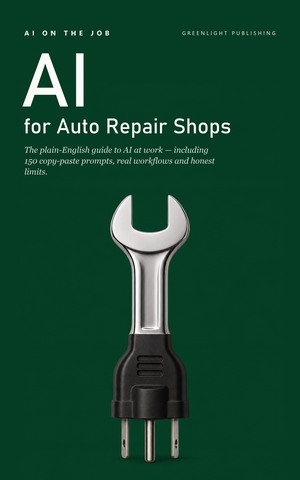
AI on the Job: Auto Repair Shops Edition
Twelve chapters, 150 copy-paste prompts, a glossary that assumes nothing, and a thirty-day plan to get there. Every figure on this page is from it.