013 of 025 · Licensed Professions
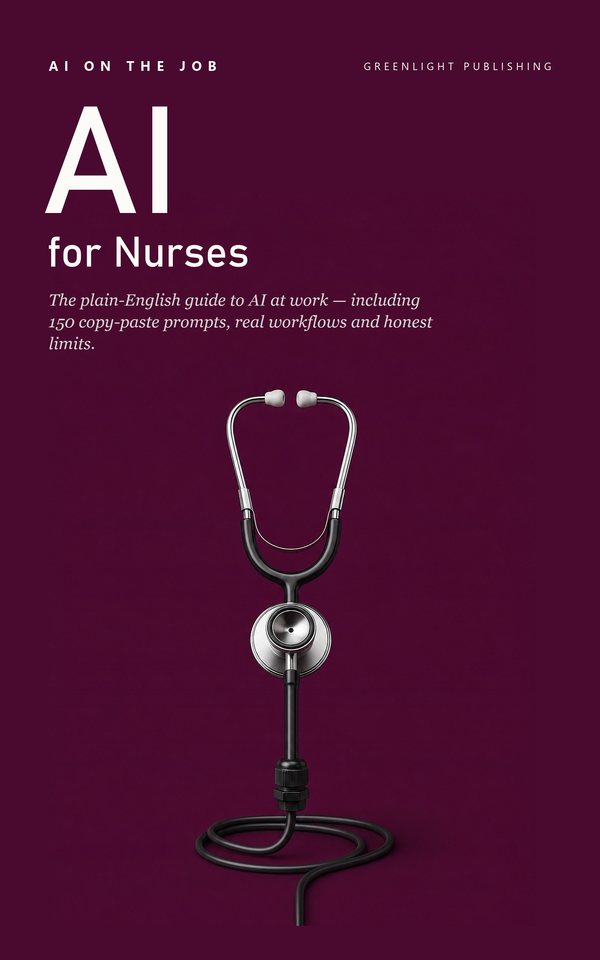
AI forNurses
It has never been in the room. This is for report, for your charting voice, for the message you rehearse in the shower, and for the career paperwork that never gets finished.
Paperback · English
USD 9.99
6 × 9 inch paperback · black-and-white pages · matte cover
Shipping and tax are calculated at checkout.
Lulu handles secure checkout, printing and delivery. You can review the full total before paying.
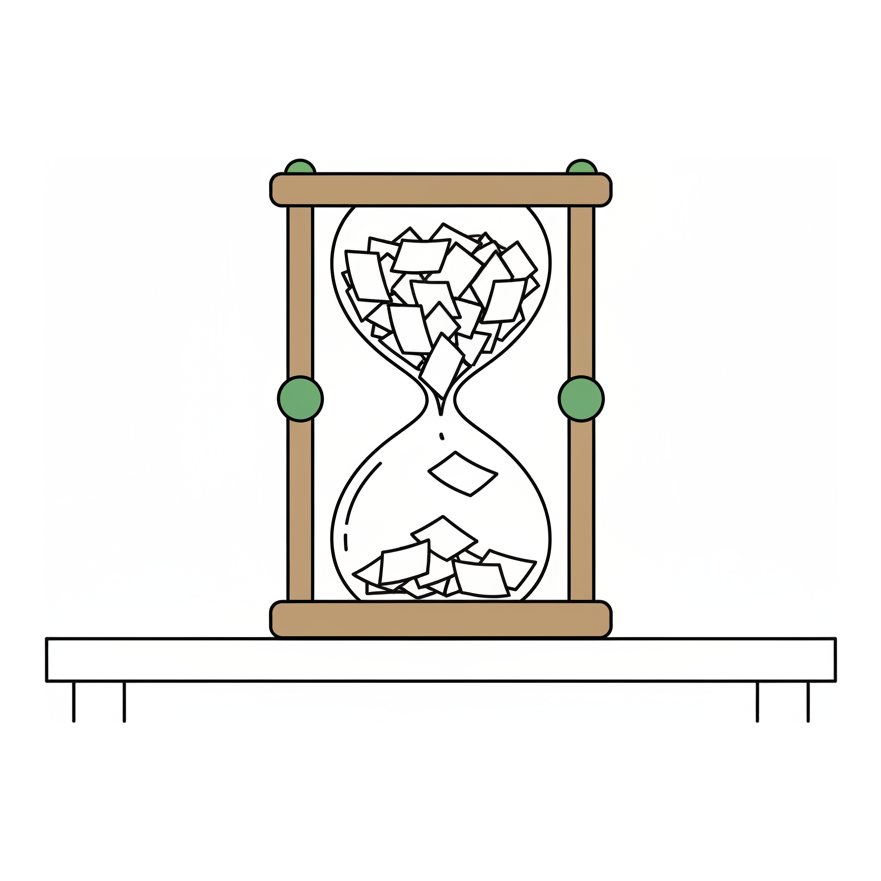
eleven and a half hours
a week.
That’s eleven and a half hours in a normal week. Your weeks aren’t identical — some are career-heavy, some are study-heavy, some are survive-the-stretch-of-three-in-a-row. Treat the table as an average across a working month. Your first week will be slower; you’re learning a tool. By week three the numbers are realistic, and Chapter 12 gives you the 30-day plan built around 12-hour shifts.
Where the hours come from
- Chapter 4Report-sheet chaos, charting that runs past shift end~2.5 hours
- Chapter 5Messages you dread, conversations you rehearse in the shower~2 hours
- Chapter 6Career paperwork that never gets finished~2 hours
- Chapter 7Studying the slow way~2 hours
- Chapter 8Shift admin — agendas, swaps, the brain that won’t clock out~1.5 hours
- Chapter 9The getting-ahead work you keep postponing~1.5 hours
Twelve chapters.
150 copy-paste prompts, twelve chapters that build on each other, a plain-word glossary, and a thirty-day plan to finish on.
Then: The Prompt Library, Glossary, The AI on the Job Series and About This Edition.
Read the opening before you decide.
Not a sample that stops mid-sentence — the whole first section, as printed, the title of every prompt in the library, and the guide to the trade.
Prompt #1.
Printed exactly as it appears in the book. The yellow parts are the blanks you fill in — there are thousands across the 150 prompts, and they are why this works on your trade rather than a generic one.
COPY THIS — Prompt #1 · Your permanent profile
Paste into the custom instructions / profile box: “I’m a [RN / LPN] with [N] years of experience, currently working [UNIT/SETTING — e.g., med-surg nights at a mid-size community hospital; no facility names]. I use you for practice scenarios, study help, templates, and career writing — never for real patient information. Every patient case we discuss is fictional. Never ask me for details about real patients, and if anything I write could identify a real person — a name, a room or bed number, a date of care, a rare diagnosis with specifics — stop and warn me before answering. Nothing you write is ever a source for drug doses, protocols, or clinical decisions; when those come up, remind me to verify against my facility’s approved references. My writing style: plain, professional, brief, no exclamation points.”
One of 150 in AI for Nurses.
A book for the work you do.
Paperback · English
USD 9.99
6 × 9 inch paperback · black-and-white pages · matte cover
Shipping and tax are calculated at checkout.
Lulu handles secure checkout, printing and delivery. You can review the full total before paying.
The questions people actually ask.
Do I need to pay for ChatGPT or Claude to use this book?
Not yet. The free tiers of both tools will carry you through every TRY IT NOW in this book and your first few weeks of real use. You’ll know it’s time to pay (about $20/month) when you hit the daily limits during a normal week — that’s the signal the tool is earning its keep. Chapter 11 covers what the money buys.
Is this book going to tell me AI is coming for my job?
No. It takes the opposite position, and says so on page one: it is a good tool for words, it does not do your job, it does the writing around your job. The book's own last line on it is “nothing in this book ever asks you to put patient information into an AI tool. Not once. Every workflow here runs on fictional cases, generic templates, and your own career material. That’s not a limitation we apologize for. It’s the design.” You can read the whole opening, It Has Never Been in the Room, free: 2,193 words, no sign-up.
What is actually in the 150 prompts?
Eight groups: Setup & Voice (1–15), Report, Brain Sheets & Charting Skills (16–40), Communication (41–65), Career & Money (66–85), Learning & CE (86–105), The Shift Around the Shift (106–120), Getting Ahead (121–145), Admin & Momentum (146–150). Every title is listed free on the prompt page, and twelve of the prompts are printed there in full.
I have never used AI at work. Is this too advanced?
It assumes nothing. Chapter 2 is “The 30-Minute Setup” and Chapter 3 is “How to Talk to It” — the tool is set up and the one real skill is taught before anything else is asked of you. The glossary at the back explains every term the book uses.
How long is it?
It is about 30,477 words across 12 chapters, plus the 150-prompt library and the glossary; the audiobook runs 2h 30m across 20 tracks, measured from the masters on 2026-08-31. Chapters 1–3 take about an hour and everything else depends on them.
Can I order the book here?
Lulu handles secure checkout, printing and delivery. You can review the full total before paying.
Nothing in this book ever asks you to put patient information into an AI tool. Not once. Every workflow here runs on fictional cases, generic templates, and your own career material. That’s not a limitation we apologize for. It’s the design.
AI on the Job: Nurses Edition · page one