Field guide · Licensed Professions
AI for Nurses
It has never been in the room. This is for report, for your charting voice, for the message you rehearse in the shower, and for the career paperwork that never gets finished.
Words for this work: nurse, RN, LPN, LVN, nurse practitioner, NP, charge nurse, CNA, bedside, ICU, ER, school nurse, home health, med surg.
The short answer
For nurses, the writing an AI chat tool is genuinely good at is the writing around the work rather than the work itself: report-sheet chaos, charting that runs past shift end, messages you dread, conversations you rehearse in the shower, career paperwork that never gets finished, studying the slow way, shift admin — agendas, swaps, the brain that won’t clock out, and the getting-ahead work you keep postponing. Chapter by chapter that is about eleven and a half hours in a normal week — That’s eleven and a half hours in a normal week. Your weeks aren’t identical — some are career-heavy, some are study-heavy, some are survive-the-stretch-of-three-in-a-row. Treat the table as an average across a working month. Your first week will be slower; you’re learning a tool. By week three the numbers are realistic, and Chapter 12 gives you the 30-day plan built around 12-hour shifts.
What it does not do: your job. It does not report-sheet chaos, charting that runs past shift end for you without you reading it first. And it has one dangerous habit worth knowing before you type anything into it. The AI’s one dangerous habit: stating false things (doses, policies, citations, “typical” pay rates) in a confident voice. The industry calls it “hallucination.” The fix is the 60-second check: numbers, promises, rules — and for anything clinical, the AI was never the source to begin with.
Where the hours go
Six blocks of writing, largest first, as the book counts them. The chapter each one is worked through in is on the right. These are the figures from this book's own promise page — the same table for all twenty-five books is on one page here.
- Report-sheet chaos, charting that runs past shift end~2.5 hoursChapter 4
- Messages you dread, conversations you rehearse in the shower~2 hoursChapter 5
- Career paperwork that never gets finished~2 hoursChapter 6
- Studying the slow way~2 hoursChapter 7
- Shift admin — agendas, swaps, the brain that won’t clock out~1.5 hoursChapter 8
- The getting-ahead work you keep postponing~1.5 hoursChapter 9
That’s eleven and a half hours in a normal week. Your weeks aren’t identical — some are career-heavy, some are study-heavy, some are survive-the-stretch-of-three-in-a-row. Treat the table as an average across a working month. Your first week will be slower; you’re learning a tool. By week three the numbers are realistic, and Chapter 12 gives you the 30-day plan built around 12-hour shifts.
The eight kinds of writing
The 150 prompts in the book are grouped the way the work is grouped. It is the shape of a week for nurses, whether or not you ever buy anything: if your week looks like this list, the tool has somewhere to start.
- 1–15Setup & Voice15 prompts
- 16–40Report, Brain Sheets & Charting Skills25 prompts
- 41–65Communication25 prompts
- 66–85Career & Money20 prompts
- 86–105Learning & CE20 prompts
- 106–120The Shift Around the Shift15 prompts
- 121–145Getting Ahead25 prompts
- 146–150Admin & Momentum5 prompts
All 150 titles are listed free, and twelve are printed in full.
Three of the prompts, in full
Not a sampler: these are the three the book itself rates highest. Its promise page values six blocks of writing in hours, and these come from the three worth the most — one prompt each, printed as they stand. The bracketed parts are where you type; everything else is the wording. Nine more are printed in full on the prompt page for this book, and every one of the 150 is listed there by name.
“Create one fictional [MED-SURG / ICU / ED / PEDS] patient for handoff practice — realistic but invented: history, current situation, one thing subtly worth flagging. Present it as messy raw information, the way a shift leaves it. I’ll give my SBAR report by voice. Critique me: what was out of order, what safety-critical item I buried or missed, what I rambled on, what the receiving nurse would still ask. Then let me re-give it once.”
“Draft a patient-education handout on [GENERAL TOPIC]. Sixth-grade reading level, short sections with headers, what-to-do before why-it-works, one WHEN TO CALL FOR HELP section. No drug names or doses. Mark it DRAFT — VERIFY at the top: I’ll check every clinical statement against my facility’s approved materials before this goes anywhere near a patient.”
“Help me prep to negotiate [SHIFT DIFFERENTIAL / WEEKEND PROGRAM / CERT PAY]. My data: [CURRENT RATE, WHAT NEARBY FACILITIES POST — I gathered these numbers myself; don’t add market figures from memory]. Build: my opening, the factual case (my differentials-relevant value: nights, weekends, certs, float flexibility), the specific ask, and my response if the answer is no (timeline to revisit, what would change the answer). Typical night/weekend differentials run a few dollars an hour — my local numbers are the ones that count.”
What to check, every time
Four kinds of box repeat through every task chapter. Two of them are the reason this is a book for nurses and not a book about AI.
COPY THIS
a ready prompt. Copy it, change the [BRACKETED] parts, paste it in.
TRY IT NOW
a five-minute exercise using your own real work (never real patients). Do these. They’re the whole point.
WATCH OUT
where the AI gets things wrong on this task, and the 60-second check that catches it.
RULES CORNER
the compliance flag: what never goes into a chat window, and why your license cares.
The words, in this trade
The plain-English AI vocabulary is on the series glossary. These are the ones specific to nurses — where the tool meets the paperwork that already has a name.
- PHI (Protected Health Information)
- Anything that connects health information to a person — far more than a name. Rooms, dates, ages plus details, rare conditions, small-town specifics. The one thing that never, under any circumstances, goes into a consumer AI tool. Chapter 10, Rule 1.
- Re-identification
- How “anonymized” fails: details that don’t identify alone, identifying together. If a coworker or neighbor could recognize the patient, it was PHI.
- BAA (Business Associate Agreement)
- The legal contract that lets a vendor lawfully handle PHI for your facility. Your employer’s clinical AI tools have one. Your personal ChatGPT account does not — which is the legal core of Rule 1.
- Employer-approved tools
- The only lane where AI ever touches clinical work: ambient scribes, EHR drafting features, and anything else your facility provides, governs, and trains you on. Their rules apply there; this book’s workflows live entirely outside that lane.
If you start on Monday
The order matters more than the effort. Chapter 1 is “Your Head Start”, and it is about what you already know. Chapter 2, “The 30-Minute Setup”, is thirty minutes of setup you do once. Chapter 3 is “How to Talk to It” — the one real skill, and everything after it assumes you have it. The last chapter, “Your First 30 Days”, is a dated plan rather than advice.
You can read the entire opening argument, It Has Never Been in the Room, without buying anything: 2,193 words, about 10 minutes.
Questions people actually ask
Can AI do report-sheet chaos, charting that runs past shift end for nurses?
It can write the draft; you still decide. This is the single biggest block of time in the trade — the book puts it at 2.5 hours a week in chapter 4 — and the prompt library gives it 25 worded prompts under “Report, Brain Sheets & Charting Skills”. The titles of all 150 are listed free.
Will AI replace nurses?
No, and this series argues the opposite at length. It is a good tool for words: it does the writing around the job, not the job. The book's own line is “nothing in this book ever asks you to put patient information into an AI tool. Not once. Every workflow here runs on fictional cases, generic templates, and your own career material. That’s not a limitation we apologize for. It’s the design.” The whole opening argument is free to read, 2,193 words, no sign-up.
Where does AI get things wrong in this work?
In one specific way, and it is worth knowing before you start. The AI’s one dangerous habit: stating false things (doses, policies, citations, “typical” pay rates) in a confident voice. The industry calls it “hallucination.” The fix is the 60-second check: numbers, promises, rules — and for anything clinical, the AI was never the source to begin with. Every task chapter carries a WATCH OUT box: where the AI gets things wrong on this task, and the 60-second check that catches it.
What should never go into a chat window?
That question has its own box in every task chapter — the compliance flag: what never goes into a chat window, and why your license cares. — and its own chapter: The Rules You Can’t Afford to Break. The short version is that the compliance line for nurses is not the same as the one for any other trade, which is why there are twenty-five books instead of one.
Do I need to pay for ChatGPT or Claude to do this?
Not yet. The free tiers of both tools will carry you through every TRY IT NOW in this book and your first few weeks of real use. You’ll know it’s time to pay (about $20/month) when you hit the daily limits during a normal week — that’s the signal the tool is earning its keep. Chapter 11 covers what the money buys.
How long before it actually saves time?
That’s eleven and a half hours in a normal week. Your weeks aren’t identical — some are career-heavy, some are study-heavy, some are survive-the-stretch-of-three-in-a-row. Treat the table as an average across a working month. Your first week will be slower; you’re learning a tool. By week three the numbers are realistic, and Chapter 12 gives you the 30-day plan built around 12-hour shifts.
The book this comes out of
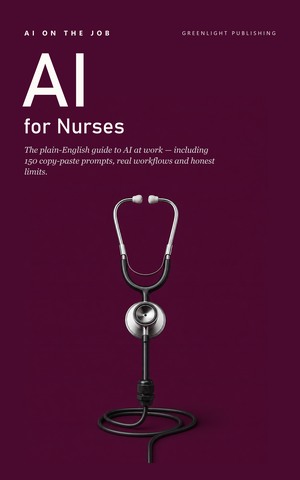
AI on the Job: Nurses Edition
150 copy-paste prompts, twelve chapters that build on each other, a plain-word glossary, and a thirty-day plan to finish on. Every figure on this page is from it.