Field guide · At Work Everywhere
AI for Fitness Trainers & Coaches
Nobody turns up at six in the morning for an app. They turn up for you — and then you go home and write the programs, the check-ins and the renewal messages.
Words for this work: personal trainer, fitness coach, gym owner, strength coach, yoga instructor, pilates, crossfit, nutrition coach, bootcamp, PT, studio owner.
The short answer
For fitness trainers & coaches, the writing an AI chat tool is genuinely good at is the writing around the work rather than the work itself: inquiry replies, consult prep, onboarding emails, check-ins, nudges, and the hard client conversations, program formatting, session notes, progress records, renewal, win-back, review, and referral messages, study notes, handouts, client education content, and the content and marketing you keep putting off. Chapter by chapter that is about eleven and a half hours in a normal week — That’s eleven and a half hours in a normal week — most of it clawed back from the evenings and Sundays this business quietly eats. Your first week will be slower; you’re learning a tool. By week three, the numbers above are realistic. Chapter 12 gives you the 30-day plan to get there.
What it does not do: your job. It does not inquiry replies, consult prep, onboarding emails for you without you reading it first. And it has one dangerous habit worth knowing before you type anything into it. The AI’s one dangerous habit: stating false things (citations, “safe” ranges, results, credentials) in a confident voice. The industry calls it “hallucination.” The fix is the 60-second check: numbers, promises, rules.
Where the hours go
Six blocks of writing, largest first, as the book counts them. The chapter each one is worked through in is on the right. These are the figures from this book's own promise page — the same table for all twenty-five books is on one page here.
- Check-ins, nudges, and the hard client conversations~3 hoursChapter 5
- Inquiry replies, consult prep, onboarding emails~2.5 hoursChapter 4
- Program formatting, session notes, progress records~2 hoursChapter 6
- The content and marketing you keep putting off~2 hoursChapter 9
- Renewal, win-back, review, and referral messages~1 hourChapter 7
- Study notes, handouts, client education content~1 hourChapter 8
That’s eleven and a half hours in a normal week — most of it clawed back from the evenings and Sundays this business quietly eats. Your first week will be slower; you’re learning a tool. By week three, the numbers above are realistic. Chapter 12 gives you the 30-day plan to get there.
The eight kinds of writing
The 150 prompts in the book are grouped the way the work is grouped. It is the shape of a week for fitness trainers & coaches, whether or not you ever buy anything: if your week looks like this list, the tool has somewhere to start.
- 1–15Setup & Voice15 prompts
- 16–40Client Acquisition25 prompts
- 41–65Client Communication25 prompts
- 66–85Programming Support & Documentation20 prompts
- 86–105Retention & Reviews20 prompts
- 106–120Content & Knowledge15 prompts
- 121–145Marketing & Growth25 prompts
- 146–150Admin & Momentum5 prompts
All 150 titles are listed free, and twelve are printed in full.
Three of the prompts, in full
Not a sampler: these are the three the book itself rates highest. Its promise page values six blocks of writing in hours, and these come from the three worth the most — one prompt each, printed as they stand. The bracketed parts are where you type; everything else is the wording. Nine more are printed in full on the prompt page for this book, and every one of the 150 is listed there by name.
“Here’s this week’s check-in from client [FAKE INITIALS] (stripped of anything medical): [PASTE/SUMMARIZE]. My coaching reaction: [VOICE-RAMBLE — what you noticed, the one adjustment you’ve decided, what to celebrate]. Write my reply: open with their specific win named exactly, address the struggle with the adjustment I stated — add no training or nutrition changes I didn’t give — end with one question that proves I read their week. My voice, under 120 words.”
“A prospect just reached out: [PASTE THEIR MESSAGE/FORM ANSWERS — no full name needed]. Write my reply: warm greeting, reflect their stated goal in their own words, one genuinely useful question, then offer a free [15/20]-minute consult with two specific times: [OPTION 1] / [OPTION 2]. No price talk yet, no pressure. Under 80 words.”
“Here is a training block I wrote — every exercise, set, rep, RPE, tempo, and rest is mine and must not change: [PASTE]. Format into a clean client-facing plan: phase name and dates, two-sentence ‘goal of this block’ intro for my approval, each day as a table (exercise / sets×reps / RPE / rest / my cue), notes section with only my notes. Do not add, remove, swap, or improve anything. List questions about ambiguities at the end instead of guessing.”
What to check, every time
Four kinds of box repeat through every task chapter. Two of them are the reason this is a book for fitness trainers & coaches and not a book about AI.
COPY THIS
a ready prompt. Copy it, change the [BRACKETED] parts, paste it in.
TRY IT NOW
a five-minute exercise using your own real work. Do these. They’re the whole point.
WATCH OUT
where the AI gets things wrong on this task, and the 60-second check that catches it.
RULES CORNER
the compliance flag: what never goes into a chat window, and why.
The words, in this trade
The plain-English AI vocabulary is on the series glossary. These are the ones specific to fitness trainers & coaches — where the tool meets the paperwork that already has a name.
- Scope of practice
- The professional boundary drawn by your certification, your insurer, and in places the law: you educate and program exercise; you don’t diagnose, treat, or prescribe. The AI drifts across it constantly — the scope screen (Prompt #10) catches it.
- The nutrition line
- General healthy-eating education is broadly trainer territory; individualized meal plans and medical nutrition therapy are legally restricted in a number of states. Where the line sits varies — verify yours with your state and certifying body.
- PAR-Q
- The physical activity readiness questionnaire (and its cousins). Client health information that lives in your own records — never in a chat window.
If you start on Monday
The order matters more than the effort. Chapter 1 is “Your Head Start”, and it is about what you already know. Chapter 2, “The 30-Minute Setup”, is thirty minutes of setup you do once. Chapter 3 is “How to Talk to It” — the one real skill, and everything after it assumes you have it. The last chapter, “Your First 30 Days”, is a dated plan rather than advice.
You can read the entire opening argument, Nobody Turns Up at Six for an App, without buying anything: 2,195 words, about 10 minutes.
Questions people actually ask
Can AI do check-ins, nudges, and the hard client conversations for fitness trainers & coaches?
It can write the draft; you still decide. This is the single biggest block of time in the trade — the book puts it at 3 hours a week in chapter 5 — and the prompt library gives it 25 worded prompts under “Client Acquisition”. The titles of all 150 are listed free.
Will AI replace fitness trainers & coaches?
No, and this series argues the opposite at length. It is a good tool for words: it does the writing around the job, not the job. The book's own line is “this book will not tell you AI is magic. It’s a power tool. It kicks. We’ll show you where — and for a trainer, “where” includes places that can cost you your certification, your insurance, or a client’s trust. Chapter 10 is short and you will read it.” The whole opening argument is free to read, 2,195 words, no sign-up.
Where does AI get things wrong in this work?
In one specific way, and it is worth knowing before you start. The AI’s one dangerous habit: stating false things (citations, “safe” ranges, results, credentials) in a confident voice. The industry calls it “hallucination.” The fix is the 60-second check: numbers, promises, rules. Every task chapter carries a WATCH OUT box: where the AI gets things wrong on this task, and the 60-second check that catches it.
What should never go into a chat window?
That question has its own box in every task chapter — the compliance flag: what never goes into a chat window, and why. — and its own chapter: The Rules You Can’t Afford to Break. The short version is that the compliance line for fitness trainers & coaches is not the same as the one for any other trade, which is why there are twenty-five books instead of one.
Do I need to pay for ChatGPT or Claude to do this?
Not yet. The free tiers of both tools will carry you through this book’s TRY IT NOW exercises and your first weeks of real use. You’ll know it’s time to pay (roughly $20/month) when you hit the free tier’s daily limits on a normal coaching day — that’s the signal the tool is earning its keep. Chapter 11 covers what the money buys.
How long before it actually saves time?
That’s eleven and a half hours in a normal week — most of it clawed back from the evenings and Sundays this business quietly eats. Your first week will be slower; you’re learning a tool. By week three, the numbers above are realistic. Chapter 12 gives you the 30-day plan to get there.
The book this comes out of
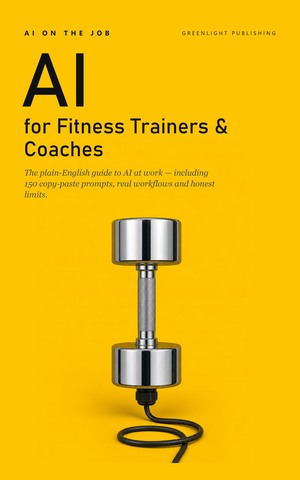
AI on the Job: Fitness Trainers & Coaches Edition
150 copy-paste prompts, twelve chapters that build on each other, a plain-word glossary, and a thirty-day plan to finish on. Every figure on this page is from it.