Field guide · Licensed Professions
AI for Medical Billers & Coders
The first AI you met in this job was working for the payer. This one works for you: appeals, provider queries, and denials that come back before lunch.
Words for this work: medical biller, medical coder, coding, RCM, revenue cycle, claims, CPT, ICD-10, billing specialist, denials, practice manager.
The short answer
For medical billers & coders, the writing an AI chat tool is genuinely good at is the writing around the work rather than the work itself: decoding denials and drafting appeals from scratch, provider queries, patient billing letters, payer escalations, worklist wrangling, client and manager reports, study plans, ceu notes, the resume you keep postponing, payer bulletin reading, cheat sheets, training materials, and the outreach and career-building you keep putting off. Chapter by chapter that is about eleven hours in a normal week — That’s eleven hours in a normal week. Your first week will be slower — you’re learning a tool. By week three, the numbers above are realistic. Chapter 12 gives you the 30-day plan to get there.
What it does not do: your job. It does not decoding denials and drafting appeals from scratch for you without you reading it first. And it has one dangerous habit worth knowing before you type anything into it. The AI’s one dangerous habit: stating false things (remark-code meanings, filing deadlines, payer policies that don’t exist) in a confident voice. The industry calls it “hallucination.” The fix is the 60-second check: numbers, promises, rules.
Where the hours go
Six blocks of writing, largest first, as the book counts them. The chapter each one is worked through in is on the right. These are the figures from this book's own promise page — the same table for all twenty-five books is on one page here.
- Decoding denials and drafting appeals from scratch~3 hoursChapter 4
- Provider queries, patient billing letters, payer escalations~2 hoursChapter 5
- Worklist wrangling, client and manager reports~2 hoursChapter 6
- Payer bulletin reading, cheat sheets, training materials~1.5 hoursChapter 8
- The outreach and career-building you keep putting off~1.5 hoursChapter 9
- Study plans, CEU notes, the resume you keep postponing~1 hourChapter 7
That’s eleven hours in a normal week. Your first week will be slower — you’re learning a tool. By week three, the numbers above are realistic. Chapter 12 gives you the 30-day plan to get there.
The eight kinds of writing
The 150 prompts in the book are grouped the way the work is grouped. It is the shape of a week for medical billers & coders, whether or not you ever buy anything: if your week looks like this list, the tool has somewhere to start.
- 1–15Setup & Voice15 prompts
- 16–40Denials & Appeals25 prompts
- 41–65Communication25 prompts
- 66–85The Operation20 prompts
- 86–105Credentials & Standing20 prompts
- 106–120The Knowledge Work15 prompts
- 121–145Marketing & Growth25 prompts
- 146–150Admin & Momentum5 prompts
All 150 titles are listed free, and twelve are printed in full.
Three of the prompts, in full
Not a sampler: these are the three the book itself rates highest. Its promise page values six blocks of writing in hours, and these come from the three worth the most — one prompt each, printed as they stand. The bracketed parts are where you type; everything else is the wording. Nine more are printed in full on the prompt page for this book, and every one of the 150 is listed there by name.
“I’m working a denial. Payer type: [TYPE]. Service category: [PLAIN DESCRIPTION]. Denial codes: [CARC + RARCs]. Plain English: what does this combination usually mean, the 3 most likely root causes in order, what exactly do I check in the documentation, claim, and payer policy to confirm which — and the usual fix path for each (corrected claim vs. reconsideration vs. appeal)? Flag every code meaning and deadline as VERIFY against the official lists and my payer’s materials.”
“Write my 10 standard billing-office messages, in the voice you learned from my samples: (1) new-balance statement cover note, (2) payment received thank-you, (3) claim-in-process status reply, (4) we-need-your-updated-insurance request, (5) COB update request, (6) payment-plan confirmation, (7) missed-payment-plan-installment reminder, (8) records/itemized-bill fulfillment note, (9) refund-on-the-way note, (10) balance-resolved confirmation. Each under 60 words, plain English, [BRACKETS] for names, amounts, dates.”
“Draft a small-balance and write-off policy for [MANAGER/CLIENT] approval: thresholds as [BLANKS], categories (small balance, uncollectible after N touches, timely-filing loss — tracked separately because those are OUR misses), approval levels, and the monthly report line each category feeds. FLAG AT TOP: this is a draft for management/compliance approval — routine write-offs of patient responsibility raise compliance issues; nothing here is policy until approved.”
What to check, every time
Four kinds of box repeat through every task chapter. Two of them are the reason this is a book for medical billers & coders and not a book about AI.
COPY THIS
a ready prompt. Copy it, change the [BRACKETED] parts, paste it in.
TRY IT NOW
a five-minute exercise using a de-identified version of your own real work. Do these. They’re the whole point.
WATCH OUT
where the AI gets things wrong on this task, and the 60-second check that catches it.
RULES CORNER
the compliance flag: what never goes into a chat window, and why.
The words, in this trade
The plain-English AI vocabulary is on the series glossary. These are the ones specific to medical billers & coders — where the tool meets the paperwork that already has a name.
- PHI (protected health information)
- Any individually identifiable health information — which means claims data: names, DOBs, member IDs, dates of service, diagnoses tied to a person. The thing that never enters a chat window. See Chapter 10, Rule 1.
- The authority hierarchy
- Documentation → current code sets and official guidelines → NCCI edits and payer policy → then the claim. The chain that decides every coding question. The AI sits below it, translating — never in it.
If you start on Monday
The order matters more than the effort. Chapter 1 is “Your Head Start”, and it is about what you already know. Chapter 2, “The 30-Minute Setup”, is thirty minutes of setup you do once. Chapter 3 is “How to Talk to It” — the one real skill, and everything after it assumes you have it. The last chapter, “Your First 30 Days”, is a dated plan rather than advice.
You can read the entire opening argument, The Other Side Already Has One, without buying anything: 2,200 words, about 10 minutes.
Questions people actually ask
Can AI do decoding denials and drafting appeals from scratch for medical billers & coders?
It can write the draft; you still decide. This is the single biggest block of time in the trade — the book puts it at 3 hours a week in chapter 4 — and the prompt library gives it 25 worded prompts under “Denials & Appeals”. The titles of all 150 are listed free.
Will AI replace medical billers & coders?
No, and this series argues the opposite at length. It is a good tool for words: it does the writing around the job, not the job. The book's own line is “this book will not tell you AI is magic. It’s a power tool. It kicks. We’ll show you where.” The whole opening argument is free to read, 2,200 words, no sign-up.
Where does AI get things wrong in this work?
In one specific way, and it is worth knowing before you start. The AI’s one dangerous habit: stating false things (remark-code meanings, filing deadlines, payer policies that don’t exist) in a confident voice. The industry calls it “hallucination.” The fix is the 60-second check: numbers, promises, rules. Every task chapter carries a WATCH OUT box: where the AI gets things wrong on this task, and the 60-second check that catches it.
What should never go into a chat window?
That question has its own box in every task chapter — the compliance flag: what never goes into a chat window, and why. — and its own chapter: The Rules You Can’t Afford to Break. The short version is that the compliance line for medical billers & coders is not the same as the one for any other trade, which is why there are twenty-five books instead of one.
Do I need to pay for ChatGPT or Claude to do this?
Not yet. The free tiers of both tools will carry you through this entire book’s TRY IT NOW exercises and your first few weeks of real use. You’ll know it’s time to pay (roughly $20/month) when you hit the free tier’s daily limits during a normal workday — that’s the signal the tool is earning its keep. Chapter 11 covers what the money buys, and what business tiers mean for a billing company.
How long before it actually saves time?
That’s eleven hours in a normal week. Your first week will be slower — you’re learning a tool. By week three, the numbers above are realistic. Chapter 12 gives you the 30-day plan to get there.
The book this comes out of
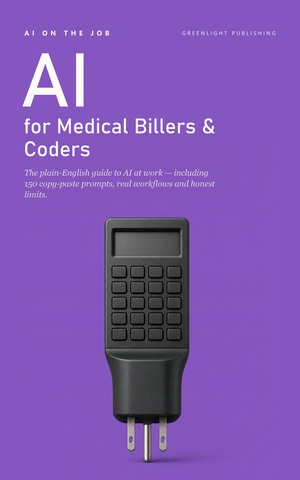
AI on the Job: Medical Billers & Coders Edition
Twelve chapters and 150 ready prompts, a glossary that explains the words nobody explained, and thirty days of small steps at the end. Every figure on this page is from it.