Field guide · Licensed Professions
AI for Pharmacists
Somebody at the window has already asked it about their medicine, and most of the page was right. This book is for the words around your practice, never for the drug reference.
Words for this work: pharmacist, pharmacy, PharmD, pharmacy technician, retail pharmacy, dispensing, RPh, compounding, counselling patients.
The short answer
For pharmacists, the writing an AI chat tool is genuinely good at is the writing around the work rather than the work itself: rejection triage, prior auth packages, appeal letters, patient handouts, outreach scripts, follow-up calls, business paperwork, pbm letters, sops, schedules, review replies, resume, career documents, distilling updates, training materials, ce wrangling, and the marketing and growth work you keep deferring. Chapter by chapter that is about eleven hours in a normal week — That’s eleven hours in a normal week. Your first week will be slower — you’re learning a tool. By week three, the numbers above are realistic. Chapter 12 gives you the 30-day plan to get there.
What it does not do: your job. It does not rejection triage, prior auth packages, appeal letters for you without you reading it first. And it has one dangerous habit worth knowing before you type anything into it. The AI’s one dangerous habit: stating false things (drug facts, plan policies, legal specifics) in a confident voice. The industry calls it “hallucination.” The fix is the 60-second check — numbers, promises, rules — plus full verification of anything clinical against your references.
Where the hours go
Six blocks of writing, largest first, as the book counts them. The chapter each one is worked through in is on the right. These are the figures from this book's own promise page — the same table for all twenty-five books is on one page here.
- Rejection triage, prior auth packages, appeal letters~3 hoursChapter 4
- Patient handouts, outreach scripts, follow-up calls~2 hoursChapter 5
- The marketing and growth work you keep deferring~2 hoursChapter 9
- Business paperwork, PBM letters, SOPs, schedules~1.5 hoursChapter 6
- Distilling updates, training materials, CE wrangling~1.5 hoursChapter 8
- Review replies, resume, career documents~1 hourChapter 7
That’s eleven hours in a normal week. Your first week will be slower — you’re learning a tool. By week three, the numbers above are realistic. Chapter 12 gives you the 30-day plan to get there.
The eight kinds of writing
The 150 prompts in the book are grouped the way the work is grouped. It is the shape of a week for pharmacists, whether or not you ever buy anything: if your week looks like this list, the tool has somewhere to start.
- 1–15Setup & Voice15 prompts
- 16–40The Insurance Battle25 prompts
- 41–65Patient Communication25 prompts
- 66–85The Business20 prompts
- 86–105Standing & Career20 prompts
- 106–120The Knowledge Work15 prompts
- 121–145Marketing & Growth25 prompts
- 146–150Admin & Momentum5 prompts
All 150 titles are listed free, and twelve are printed in full.
Three of the prompts, in full
Not a sampler: these are the three the book itself rates highest. Its promise page values six blocks of writing in hours, and these come from the three worth the most — one prompt each, printed as they stand. The bracketed parts are where you type; everything else is the wording. Nine more are printed in full on the prompt page for this book, and every one of the 150 is listed there by name.
“Rejection situation: [CODE + MESSAGE, e.g., 75 — prior authorization required / 79 — refill too soon / 70 — product not covered]. Drug class: [CLASS, no patient details]. Give me: (1) NEXT ACTIONS in order, split into WHAT THE TECH DOES and WHAT THE PHARMACIST DOES; (2) the one-sentence counter explanation for the patient — calm, no jargon, ends with what happens next and when; (3) what to have ready before we call the plan. Mark plan-variable items [CHECK THE PAYER SHEET]. Do not suggest alternative drugs.”
“Write a one-page patient handout reinforcing counseling for a patient starting [DRUG CLASS — generic situation]. Sections: WHAT THIS MEDICATION DOES (2 sentences, plain), HOW TO TAKE IT (general points as [VERIFY] blanks I complete from the monograph), WHAT’S NORMAL AT FIRST, WHEN TO CALL US, WHEN TO CALL YOUR PRESCRIBER. 8th-grade level, warm, no fear language, no exclamation points. No doses, interactions, or side-effect frequencies — leave as [PHARMACIST COMPLETES FROM MONOGRAPH]. Footer: ‘This sheet supports — never replaces — talking with your pharmacist.’”
“Write my pharmacy’s Google Business Profile: (1) a business description under 750 characters naming what makes an independent pharmacy different — real people answering the phone, med sync, same-day transfers, immunizations — using only services I actually offer: [LIST]; (2) a services list with one plain sentence each; (3) answers to the 8 questions patients always ask (insurance? transfers? flu-shot appointments? delivery? speed on new prescriptions? med sync? compounding? Medicare plans?) — each 2–3 sentences in my voice, unknown facts as [BLANK], the insurance answer as ‘we work with most plans — call us and we’ll check yours in one minute.’ No outcome claims about any health service.”
What to check, every time
Four kinds of box repeat through every task chapter. Two of them are the reason this is a book for pharmacists and not a book about AI.
COPY THIS
a ready prompt. Copy it, change the [BRACKETED] parts, paste it in.
TRY IT NOW
a five-minute exercise using your own real work. Do these. They’re the whole point.
WATCH OUT
where the AI gets things wrong on this task, and the 60-second check that catches it.
RULES CORNER
the compliance flag: what never goes into a chat window, and why.
The words, in this trade
The plain-English AI vocabulary is on the series glossary. These are the ones specific to pharmacists — where the tool meets the paperwork that already has a name.
- PHI (protected health information)
- Anything connecting health information to a person — names, birthdates, member IDs, fill histories, and combinations of details that identify together. Never enters a consumer AI tool, under any setting, on any tier.
- BAA (business associate agreement)
- The contract that must exist before any vendor’s tool touches PHI. No consumer AI account at any price is one.
- Corresponding responsibility
- Your personal, legal duty on every controlled-substance fill. Entirely human, entirely yours; no workflow in this book approaches it.
- Free tier / paid tier / business tier
- Free gets you started; ~$20/month removes daily limits; business tiers (~$25–30/user) add contractual data terms for your store’s information. None of them changes the PHI rule.
If you start on Monday
The order matters more than the effort. Chapter 1 is “Your Head Start”, and it is about what you already know. Chapter 2, “The 30-Minute Setup”, is thirty minutes of setup you do once. Chapter 3 is “How to Talk to It” — the one real skill, and everything after it assumes you have it. The last chapter, “Your First 30 Days”, is a dated plan rather than advice.
You can read the entire opening argument, Somebody Already Asked It About Their Medicine, without buying anything: 2,184 words, about 9 minutes.
Questions people actually ask
Can AI do rejection triage, prior auth packages, appeal letters for pharmacists?
It can write the draft; you still decide. This is the single biggest block of time in the trade — the book puts it at 3 hours a week in chapter 4 — and the prompt library gives it 25 worded prompts under “The Insurance Battle”. The titles of all 150 are listed free.
Will AI replace pharmacists?
No, and this series argues the opposite at length. It is a good tool for words: it does the writing around the job, not the job. The book's own line is “this book will not tell you AI is magic, and it will never — not once — tell you to use AI as a drug reference. It’s a power tool for the words around your practice: the letters, the explanations, the organizing. The clinical judgment stays exactly where your license already puts it.” The whole opening argument is free to read, 2,184 words, no sign-up.
Where does AI get things wrong in this work?
In one specific way, and it is worth knowing before you start. The AI’s one dangerous habit: stating false things (drug facts, plan policies, legal specifics) in a confident voice. The industry calls it “hallucination.” The fix is the 60-second check — numbers, promises, rules — plus full verification of anything clinical against your references. Every task chapter carries a WATCH OUT box: where the AI gets things wrong on this task, and the 60-second check that catches it.
What should never go into a chat window?
That question has its own box in every task chapter — the compliance flag: what never goes into a chat window, and why. — and its own chapter: The Rules You Can’t Afford to Break. The short version is that the compliance line for pharmacists is not the same as the one for any other trade, which is why there are twenty-five books instead of one.
Do I need to pay for ChatGPT or Claude to do this?
Not yet. The free tiers of both tools will carry you through this book’s TRY IT NOW exercises and your first weeks of real use. You’ll know it’s time to pay (roughly $20/month) when you hit the daily limits during a normal workday — that’s the signal the tool is earning its keep. Chapter 11 covers what the money buys.
How long before it actually saves time?
That’s eleven hours in a normal week. Your first week will be slower — you’re learning a tool. By week three, the numbers above are realistic. Chapter 12 gives you the 30-day plan to get there.
The book this comes out of
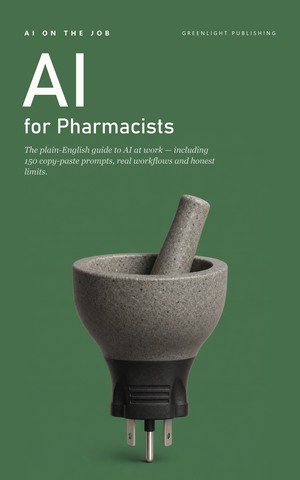
AI on the Job: Pharmacists Edition
150 copy-paste prompts across twelve chapters, a glossary with no jargon in it, and a thirty-day plan that starts with one thing on Monday. Every figure on this page is from it.