Field guide · Licensed Professions
AI for Paralegals
You know the brief with the cases that did not exist. Nothing here goes out under its name — it drafts, and you are still the one who checks.
Words for this work: paralegal, legal assistant, law clerk, legal secretary, litigation support, discovery, court filings, e-discovery, law firm.
The short answer
For paralegals, the writing an AI chat tool is genuinely good at is the writing around the work rather than the work itself: first drafts of routine documents, the proofread pass, client updates, records requests, the memos nobody reads, deposition summaries, indexes, logs, chronologies, the career file: resume, certification study, the raise case, reading, translating, and cheat-sheeting the law around your cases, and the getting-ahead work you keep postponing. Chapter by chapter that is about ten and a half hours in a normal week — That’s ten and a half hours in a normal week. Your first week will be slower — you’re learning a tool. By week three, the numbers above are realistic. Chapter 12 gives you the 30-day plan to get there.
What it does not do: your job. It does not first drafts of routine documents, the proofread pass for you without you reading it first. And it has one dangerous habit worth knowing before you type anything into it. The AI’s one dangerous habit: stating false things in a confident voice. The industry calls it “hallucination.” In legal work its signature form is the invented case citation — real-sounding authority for cases that don’t exist. The fix is never the AI checking itself; it’s you, in Westlaw, Lexis, or the official source, every time.
Where the hours go
Six blocks of writing, largest first, as the book counts them. The chapter each one is worked through in is on the right. These are the figures from this book's own promise page — the same table for all twenty-five books is on one page here.
- First drafts of routine documents, the proofread pass~3 hoursChapter 4
- Client updates, records requests, the memos nobody reads~2 hoursChapter 5
- Deposition summaries, indexes, logs, chronologies~2 hoursChapter 6
- Reading, translating, and cheat-sheeting the law around your cases~1.5 hoursChapter 8
- The career file: resume, certification study, the raise case~1 hourChapter 7
- The getting-ahead work you keep postponing~1 hourChapter 9
That’s ten and a half hours in a normal week. Your first week will be slower — you’re learning a tool. By week three, the numbers above are realistic. Chapter 12 gives you the 30-day plan to get there.
The eight kinds of writing
The 150 prompts in the book are grouped the way the work is grouped. It is the shape of a week for paralegals, whether or not you ever buy anything: if your week looks like this list, the tool has somewhere to start.
- 1–15Setup & Voice15 prompts
- 16–40Drafting Support25 prompts
- 41–65Communication25 prompts
- 66–85Organization & the Docket20 prompts
- 86–105Career & Credentials20 prompts
- 106–120The Knowledge Work15 prompts
- 121–145Getting Ahead25 prompts
- 146–150Admin & Momentum5 prompts
All 150 titles are listed free, and twelve are printed in full.
Three of the prompts, in full
Not a sampler: these are the three the book itself rates highest. Its promise page values six blocks of writing in hours, and these come from the three worth the most — one prompt each, printed as they stand. The bracketed parts are where you type; everything else is the wording. Nine more are printed in full on the prompt page for this book, and every one of the 150 is listed there by name.
“Draft a [DOCUMENT TYPE] for this fictional matter: [FICTIONAL FACT PATTERN, BRACKETED PARTIES AND DATES]. Follow this structure from our firm’s form: [PASTE TEMPLATE HEADINGS OR REDACTED EXAMPLE]. Formal register, plain English where the form allows. Every name, date, amount, and case-specific fact as a [BRACKETED PLACEHOLDER]. Do not cite any statute, rule, or case — leave [LEGAL AUTHORITY — ATTORNEY] placeholders. Head it DRAFT FOR ATTORNEY REVIEW.”
“Draft my 10 standard client status-update templates for a [PRACTICE AREA] firm, each with [BRACKETS] and a DRAFT FOR ATTORNEY REVIEW header: filing received and under review; we filed/served [DOCUMENT]; hearing or deposition scheduled with logistics; date continued with neutral reason; documents needed from client by [DATE], itemized; discovery-stage explainer; settlement-call logistics only; quiet-period reassurance with next milestone; invoice transmittal; matter-closing shell. Plain English, warm, under 120 words each. Absolute rules: no advice, no predictions, no strong/weak characterizations, no ‘you should.’ Facts and calendar only.”
“I have verified deadlines from our docketing system for a fictional [CASE TYPE] matter: [LIST]. Do not calculate, adjust, or add any dates. Build a workback checklist: for each verified deadline, the preparation tasks for the weeks before it, in order, with [ME / ATTORNEY / VENDOR] owners. Then a one-page ‘what’s due when’ summary marked ‘ALL DATES FROM DOCKETING SYSTEM — VERIFY THERE.’”
What to check, every time
Four kinds of box repeat through every task chapter. Two of them are the reason this is a book for paralegals and not a book about AI.
COPY THIS
a ready prompt. Copy it, change the [BRACKETED] parts, paste it in.
TRY IT NOW
a five-minute exercise using fictionalized versions of your own real work. Do these. They’re the whole point.
WATCH OUT
where the AI gets things wrong on this task, and the 60-second check that catches it.
RULES CORNER
the compliance flag: what never goes into a chat window, what always gets verified, and why.
The words, in this trade
The plain-English AI vocabulary is on the series glossary. These are the ones specific to paralegals — where the tool meets the paperwork that already has a name.
- The fictional-case habit
- The discipline that keeps every workflow confidential: prompts describe invented matters with the same legal shape as your real one, or use [BRACKETS]; real details enter only your firm’s systems, afterward.
- Docketing system
- Your firm’s rules-based deadline calendar. The only authority on dates in this entire book. The AI organizes around its verified output and never computes a deadline itself.
- UPL (unauthorized practice of law)
- What a paralegal never does and AI never changes: no legal advice, no fee-setting, no signing filings. Attorney supervision and review is the system, for you and for every draft the AI touches.
If you start on Monday
The order matters more than the effort. Chapter 1 is “Your Head Start”, and it is about what you already know. Chapter 2, “The 30-Minute Setup”, is thirty minutes of setup you do once. Chapter 3 is “How to Talk to It” — the one real skill, and everything after it assumes you have it. The last chapter, “Your First 30 Days”, is a dated plan rather than advice.
You can read the entire opening argument, Nothing Goes Out Under Its Name, without buying anything: 2,193 words, about 10 minutes.
Questions people actually ask
Can AI do first drafts of routine documents, the proofread pass for paralegals?
It can write the draft; you still decide. This is the single biggest block of time in the trade — the book puts it at 3 hours a week in chapter 4 — and the prompt library gives it 25 worded prompts under “Drafting Support”. The titles of all 150 are listed free.
Will AI replace paralegals?
No, and this series argues the opposite at length. It is a good tool for words: it does the writing around the job, not the job. The book's own line is “this book will not tell you AI is magic. It’s a power tool. In a law office it kicks harder than anywhere else — it makes up case citations, it drifts into legal advice, and it does both in a confident voice. We’ll show you exactly where it kicks and exactly how the checking habits catch it. Those habits are the difference between the paralegal AI makes faster and the paralegal AI gets in trouble.” The whole opening argument is free to read, 2,193 words, no sign-up.
Where does AI get things wrong in this work?
In one specific way, and it is worth knowing before you start. The AI’s one dangerous habit: stating false things in a confident voice. The industry calls it “hallucination.” In legal work its signature form is the invented case citation — real-sounding authority for cases that don’t exist. The fix is never the AI checking itself; it’s you, in Westlaw, Lexis, or the official source, every time. Every task chapter carries a WATCH OUT box: where the AI gets things wrong on this task, and the 60-second check that catches it.
What should never go into a chat window?
That question has its own box in every task chapter — the compliance flag: what never goes into a chat window, what always gets verified, and why. — and its own chapter: The Rules You Can’t Afford to Break. The short version is that the compliance line for paralegals is not the same as the one for any other trade, which is why there are twenty-five books instead of one.
Do I need to pay for ChatGPT or Claude to do this?
Not yet. Free tiers of both tools carry you through every TRY IT NOW in this book and your first weeks of real use. You’ll know it’s time to pay (about $20/month) when you hit the daily limits during a normal workday — that’s the signal the tool is earning its keep. Chapter 11 covers what the money buys, and where your firm’s Westlaw or Lexis AI features fit in.
How long before it actually saves time?
That’s ten and a half hours in a normal week. Your first week will be slower — you’re learning a tool. By week three, the numbers above are realistic. Chapter 12 gives you the 30-day plan to get there.
The book this comes out of
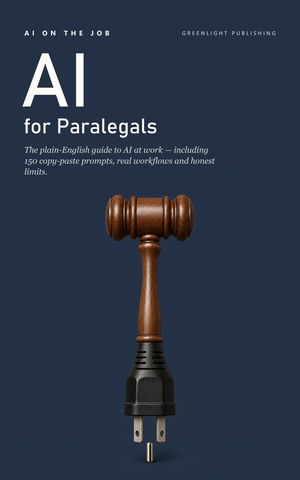
AI on the Job: Paralegals Edition
Twelve chapters, 150 prompts ready to paste, a glossary in plain words, and a thirty-day plan you can actually keep. Every figure on this page is from it.