Field guide · Licensed Professions
AI for Loan Officers & Mortgage Pros
A machine has been reading files since the nineties. The decision was never the slow part — the explaining, the document chasing and the closing week are.
Words for this work: loan officer, mortgage broker, MLO, lender, mortgage, originator, refinance, underwriting, pre-approval, processor.
The short answer
For loan officers & mortgage pros, the writing an AI chat tool is genuinely good at is the writing around the work rather than the work itself: explaining loan options and the pre-approval process, one borrower at a time, milestone updates, document chasing, “any news?” calls, condition-clearing emails, loe coaching, closing-week choreography, agent updates and past-client touches you keep meaning to send, guideline digging, scenario write-ups, bulletin reading, and marketing that sits in your drafts folder. Chapter by chapter that is about eleven and a half hours in a normal week — That’s eleven and a half hours in a normal week. Your first week will be slower — you’re learning a tool. By week three, the numbers above are realistic. Chapter 12 gives you the 30-day plan to get there.
What it does not do: your job. It does not explaining loan options and the pre-approval process, one borrower at a time for you without you reading it first. And it has one dangerous habit worth knowing before you type anything into it. The AI’s one dangerous habit: stating false things (rates, guidelines, program facts, approval odds) in a confident voice. The industry calls it “hallucination.” The fix is the 60-second check: numbers, promises, rules.
Where the hours go
Six blocks of writing, largest first, as the book counts them. The chapter each one is worked through in is on the right. These are the figures from this book's own promise page — the same table for all twenty-five books is on one page here.
- Explaining loan options and the pre-approval process, one borrower at a time~2.5 hoursChapter 4
- Milestone updates, document chasing, “any news?” calls~2.5 hoursChapter 5
- Condition-clearing emails, LOE coaching, closing-week choreography~2 hoursChapter 6
- Agent updates and past-client touches you keep meaning to send~1.5 hoursChapter 7
- Guideline digging, scenario write-ups, bulletin reading~1.5 hoursChapter 8
- Marketing that sits in your drafts folder~1.5 hoursChapter 9
That’s eleven and a half hours in a normal week. Your first week will be slower — you’re learning a tool. By week three, the numbers above are realistic. Chapter 12 gives you the 30-day plan to get there.
The eight kinds of writing
The 150 prompts in the book are grouped the way the work is grouped. It is the shape of a week for loan officers & mortgage pros, whether or not you ever buy anything: if your week looks like this list, the tool has somewhere to start.
- 1–15Setup & Voice15 prompts
- 16–40Borrower Education & Pre-Approval25 prompts
- 41–65Pipeline Communication25 prompts
- 66–85The Paperwork Machine20 prompts
- 86–105Realtor & Referral Relationships20 prompts
- 106–120The Knowledge Work15 prompts
- 121–145Marketing & Growth25 prompts
- 146–150Admin & Momentum5 prompts
All 150 titles are listed free, and twelve are printed in full.
Three of the prompts, in full
Not a sampler: these are the three the book itself rates highest. Its promise page values six blocks of writing in hours, and these come from the three worth the most — one prompt each, printed as they stand. The bracketed parts are where you type; everything else is the wording. Nine more are printed in full on the prompt page for this book, and every one of the 150 is listed there by name.
“Generic borrower profile: [E.G., FIRST-TIME BUYER, 5% DOWN, W-2 — no real details]. I’ve chosen to present: [MY OPTIONS]. Write a plain-English comparison: what each is, how they differ on down payment, mortgage insurance, and flexibility — in words, not numbers. Every figure stays blank for me to fill. Don’t recommend one; end with ‘here’s how we’ll decide together.’ No rates, no approval language. Under 250 words.”
“Build my milestone update kit. For each stage — application received, submitted to underwriting, conditional approval, appraisal back, clear to close, closing scheduled — write a BORROWER version (warm, what this means, what’s next, what I need) and an AGENT version (tight: status, next milestone, target date as [DATE], flags). Under 80 words each, [BRACKETS] for names/dates, no rates, and nothing that guarantees approval or closing — ‘conditional’ stays conditional, ‘on track’ is the ceiling. My voice.”
“Here are open conditions, retyped with no borrower-identifying details: [LIST]. For each, draft the request to the right party ([BORROWER / EMPLOYER / INSURANCE AGENT / HOA]): exactly what’s needed, the one-line reason, the format that clears it first-pass, needed-by [DATE]. Professional and specific — busy third parties who owe me nothing. Under 100 words each.”
What to check, every time
Four kinds of box repeat through every task chapter. Two of them are the reason this is a book for loan officers & mortgage pros and not a book about AI.
COPY THIS
a ready prompt. Copy it, change the [BRACKETED] parts, paste it in.
TRY IT NOW
a five-minute exercise using your own real work. Do these. They’re the whole point.
WATCH OUT
where the AI gets things wrong on this task, and the 60-second check that catches it.
RULES CORNER
the compliance flag: what never goes into a chat window, what never goes out without compliance review, and why.
The words, in this trade
The plain-English AI vocabulary is on the series glossary. These are the ones specific to loan officers & mortgage pros — where the tool meets the paperwork that already has a name.
- Draft → compliance → publish
- The standing workflow for every piece of marketing in this book. Not a hurdle; the assembly line.
- Trigger terms
- Specific credit terms (a rate, a payment amount, certain down-payment or term specifics) that, stated in an ad, can require additional disclosures under TILA. This book’s default: none in self-serve content; anything with numbers is built with compliance.
- AUS / underwriting
- The automated systems (DU/LP-class) and human underwriters who actually decide loans. The AI in this book is never either one.
If you start on Monday
The order matters more than the effort. Chapter 1 is “Your Head Start”, and it is about what you already know. Chapter 2, “The 30-Minute Setup”, is thirty minutes of setup you do once. Chapter 3 is “How to Talk to It” — the one real skill, and everything after it assumes you have it. The last chapter, “Your First 30 Days”, is a dated plan rather than advice.
You can read the entire opening argument, The Decision Was Never the Slow Part, without buying anything: 2,168 words, about 9 minutes.
Questions people actually ask
Can AI do explaining loan options and the pre-approval process, one borrower at a time for loan officers & mortgage pros?
It can write the draft; you still decide. This is the single biggest block of time in the trade — the book puts it at 2.5 hours a week in chapter 4 — and the prompt library gives it 25 worded prompts under “Borrower Education & Pre-Approval”. The titles of all 150 are listed free.
Will AI replace loan officers & mortgage pros?
No, and this series argues the opposite at length. It is a good tool for words: it does the writing around the job, not the job. The book's own line is “this book will not tell you AI is magic. It’s a power tool. It kicks. We’ll show you where — and in a business regulated the way mortgage is, “where it kicks” is half the book.” The whole opening argument is free to read, 2,168 words, no sign-up.
Where does AI get things wrong in this work?
In one specific way, and it is worth knowing before you start. The AI’s one dangerous habit: stating false things (rates, guidelines, program facts, approval odds) in a confident voice. The industry calls it “hallucination.” The fix is the 60-second check: numbers, promises, rules. Every task chapter carries a WATCH OUT box: where the AI gets things wrong on this task, and the 60-second check that catches it.
What should never go into a chat window?
That question has its own box in every task chapter — the compliance flag: what never goes into a chat window, what never goes out without compliance review, and why. — and its own chapter: The Rules You Can’t Afford to Break. The short version is that the compliance line for loan officers & mortgage pros is not the same as the one for any other trade, which is why there are twenty-five books instead of one.
Do I need to pay for ChatGPT or Claude to do this?
Not yet. The free tiers of both tools will carry you through this entire book’s TRY IT NOW exercises and your first few weeks of real use. You’ll know it’s time to pay (roughly $20/month) when you hit the free tier’s daily limits during a normal workday — that’s the signal the tool is earning its keep. Chapter 11 covers what the money buys, and when your company’s own AI-equipped platforms should carry a workflow instead.
How long before it actually saves time?
That’s eleven and a half hours in a normal week. Your first week will be slower — you’re learning a tool. By week three, the numbers above are realistic. Chapter 12 gives you the 30-day plan to get there.
The book this comes out of
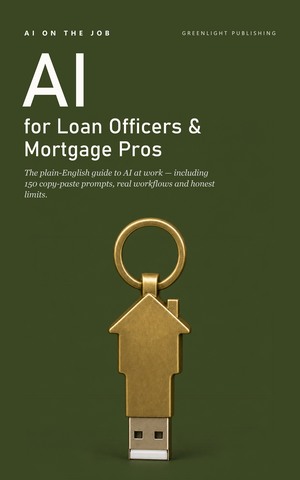
AI on the Job: Loan Officers & Mortgage Pros Edition
Twelve chapters, 150 copy-paste prompts, a glossary that assumes nothing, and a thirty-day plan to get there. Every figure on this page is from it.