Field guide · Licensed Professions
AI for Therapists & Counselors
Sooner or later a client mentions the app they talked to at two in the morning. This book is for the hour after your last client. Never for the hour with them.
Words for this work: therapist, counselor, counsellor, LCSW, LMFT, LPC, psychologist, mental health, private practice, clinician, social worker, intake.
The short answer
For therapists & counselors, the writing an AI chat tool is genuinely good at is the writing around the work rather than the work itself: templates, treatment-plan language, practice paperwork, inquiry replies, policy messages, the hard emails, superbill explanations, appeals, balance chasing, referral letters, profiles, professional visibility, handouts, worksheets, group curricula, reading piles, and the marketing you keep putting off. Chapter by chapter that is about eleven hours in a normal week — That’s eleven hours in a normal week. Your first week will be slower — you’re learning a tool. By week three, the numbers above are realistic. Chapter 12 gives you the 30-day plan to get there.
What it does not do: your job. It does not templates, treatment-plan language, practice paperwork for you without you reading it first. And it has one dangerous habit worth knowing before you type anything into it. The AI’s one dangerous habit: stating false things (statistics, CPT codes, ethics rules, citations) in a confident, warm voice. The industry calls it “hallucination.” The fix is the 60-second check: numbers, promises, rules.
Where the hours go
Six blocks of writing, largest first, as the book counts them. The chapter each one is worked through in is on the right. These are the figures from this book's own promise page — the same table for all twenty-five books is on one page here.
- Templates, treatment-plan language, practice paperwork~2.5 hoursChapter 4
- Inquiry replies, policy messages, the hard emails~2 hoursChapter 5
- Superbill explanations, appeals, balance chasing~2 hoursChapter 6
- Referral letters, profiles, professional visibility~1.5 hoursChapter 7
- Handouts, worksheets, group curricula, reading piles~1.5 hoursChapter 8
- The marketing you keep putting off~1.5 hoursChapter 9
That’s eleven hours in a normal week. Your first week will be slower — you’re learning a tool. By week three, the numbers above are realistic. Chapter 12 gives you the 30-day plan to get there.
The eight kinds of writing
The 150 prompts in the book are grouped the way the work is grouped. It is the shape of a week for therapists & counselors, whether or not you ever buy anything: if your week looks like this list, the tool has somewhere to start.
- 1–15Setup & Voice15 prompts
- 16–40The Paperwork Mountain25 prompts
- 41–65Client-Facing Communication25 prompts
- 66–85Money — Private Pay & Insurance20 prompts
- 86–105Referrals & Professional Standing20 prompts
- 106–120Clinical-Adjacent Creation15 prompts
- 121–145Ethical Marketing25 prompts
- 146–150Admin & Momentum5 prompts
All 150 titles are listed free, and twelve are printed in full.
Three of the prompts, in full
Not a sampler: these are the three the book itself rates highest. Its promise page values six blocks of writing in hours, and these come from the three worth the most — one prompt each, printed as they stand. The bracketed parts are where you type; everything else is the wording. Nine more are printed in full on the prompt page for this book, and every one of the 150 is listed there by name.
“Invent a fictional adult therapy client — realistic but entirely made up — presenting with [CONCERN]. Give me a two-paragraph vignette of a mid-treatment session using [MODALITY]. Then write a progress note for that fictional session in [SOAP / DAP / BIRP] format, concise, in language that supports medical necessity. Then explain in three bullets what makes the note defensible. Training exercise — everything stays fictional.”
“Write my 8 standard client-communication templates in my voice, [BRACKETS] for specifics: (1) new-inquiry reply — warm, fee $[FEE] and insurance/superbill status stated plainly, one next step (free [N]-minute consult), no outcome promises; (2) waitlist reply — honest wait length, referral option offered; (3) consult-call confirmation with what to expect; (4) first-appointment prep; (5) reschedule offer; (6) fee/policy reminder; (7) after-hours auto-reply with crisis block; (8) ‘not a fit’ referral-out, kind, no diagnosis language. Each under 120 words.”
“Write a one-page client handout explaining out-of-network benefits in plain English: what a superbill is, how to submit it, ‘deductible’ / ‘out-of-network benefits’ / ‘allowed amount’ in one sentence each, and the exact questions to ask their insurer — including reimbursement for CPT [90837 / 90834] and preauthorization. Friendly, neutral, 8th-grade level. State clearly that I can’t guarantee reimbursement — their plan decides.”
What to check, every time
Four kinds of box repeat through every task chapter. Two of them are the reason this is a book for therapists & counselors and not a book about AI.
COPY THIS
a ready prompt. Copy it, change the [BRACKETED] parts, paste it in.
TRY IT NOW
a five-minute exercise using your own real work (never real clients). Do these. They’re the whole point.
WATCH OUT
where the AI gets things wrong on this task, and the 60-second check that catches it.
RULES CORNER
the compliance flag: what never goes into a chat window, and why.
The words, in this trade
The plain-English AI vocabulary is on the series glossary. These are the ones specific to therapists & counselors — where the tool meets the paperwork that already has a name.
- BAA (Business Associate Agreement)
- The signed contract in which a vendor legally accepts HIPAA obligations for protected health information it handles. The dividing line between clinical-grade tools and everything else. No BAA, no client data — no exceptions.
- PHI (protected health information)
- Health information tied to an identifiable person. In your practice, assume anything about a real client qualifies — and remember your confidentiality ethic covers even more than HIPAA does, including who your clients are at all.
- Superbill
- The itemized receipt (with CPT and diagnosis codes) an out-of-network client submits to their insurer for possible reimbursement. Prompt #66 explains it to clients so you stop doing so weekly.
- CPT code
- The billing code for a service (90837 for a 53+ minute session, 90834 for 38–52). The AI does not reliably know codes — every code in every document comes from your billing records.
- Note debt
- The pile of unfinished documentation and the Sunday it eats. Chapter 4’s target: better templates and a retrained note-writing muscle, with clinical content never leaving your own systems.
If you start on Monday
The order matters more than the effort. Chapter 1 is “Your Head Start”, and it is about what you already know. Chapter 2, “The 30-Minute Setup”, is thirty minutes of setup you do once. Chapter 3 is “How to Talk to It” — the one real skill, and everything after it assumes you have it. The last chapter, “Your First 30 Days”, is a dated plan rather than advice.
You can read the entire opening argument, The Hour After Your Last Client, without buying anything: 2,167 words, about 9 minutes.
Questions people actually ask
Can AI do templates, treatment-plan language, practice paperwork for therapists & counselors?
It can write the draft; you still decide. This is the single biggest block of time in the trade — the book puts it at 2.5 hours a week in chapter 4 — and the prompt library gives it 25 worded prompts under “The Paperwork Mountain”. The titles of all 150 are listed free.
Will AI replace therapists & counselors?
No, and this series argues the opposite at length. It is a good tool for words: it does the writing around the job, not the job. The book's own line is “This book will not tell you AI is magic — it’s a power tool, it kicks, and we’ll show you where. And this book will never ask you to put a client anywhere near a chat window. The line runs through every page: AI for the business of your practice. Never for the content of your sessions. Chapter 10 explains exactly where that line sits and why.” The whole opening argument is free to read, 2,167 words, no sign-up.
Where does AI get things wrong in this work?
In one specific way, and it is worth knowing before you start. The AI’s one dangerous habit: stating false things (statistics, CPT codes, ethics rules, citations) in a confident, warm voice. The industry calls it “hallucination.” The fix is the 60-second check: numbers, promises, rules. Every task chapter carries a WATCH OUT box: where the AI gets things wrong on this task, and the 60-second check that catches it.
What should never go into a chat window?
That question has its own box in every task chapter — the compliance flag: what never goes into a chat window, and why. — and its own chapter: The Rules You Can’t Afford to Break. The short version is that the compliance line for therapists & counselors is not the same as the one for any other trade, which is why there are twenty-five books instead of one.
Do I need to pay for ChatGPT or Claude to do this?
Not yet. Free tiers of both tools carry you through this book’s TRY IT NOW exercises and your first weeks of real use. You’ll know it’s time to pay (about $20/month) when you hit daily limits during a normal workday — that’s the signal the tool is earning its keep. Chapter 11 covers what the money buys.
How long before it actually saves time?
That’s eleven hours in a normal week. Your first week will be slower — you’re learning a tool. By week three, the numbers above are realistic. Chapter 12 gives you the 30-day plan to get there.
The book this comes out of
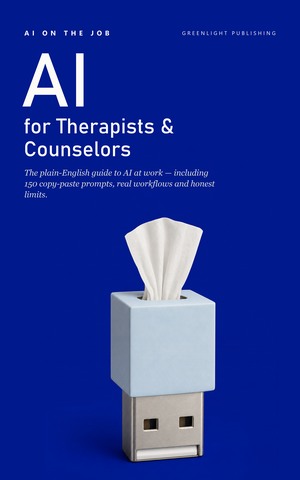
AI on the Job: Therapists & Counselors Edition
Twelve chapters, 150 copy-paste prompts, a glossary that assumes nothing, and a thirty-day plan to get there. Every figure on this page is from it.